
CLINICAL DECISION SUPPORT PLATFORM
Every cancer decision deserves a whole view of the patient.
PROTEGER combines artificial intelligence and geriatric oncology assessment to support treatment decisions that are personalized, informed and safe for older adults with cancer.
PROTEGER intervenes at a critical point —the treatment decision— and from there generates a chain of value that reaches the patient, the physician, the hospital and the health system.
PROTEGER is a clinical decision support platform built on artificial intelligence — the only one of its kind in Chile and Latin America — developed to assist oncology and geriatric oncology teams in making treatment decisions for older adults with cancer. Through an ecosystem of AI models, PROTEGER integrates and analyzes clinical, oncological and geriatric information to produce individualized recommendations that help choose the right treatment for each patient, with the clinical team always at the center of the decision.
THE JOURNEY WITH PROTEGER
Intelligence that looks after decisions
From the first conversation to clinical follow-up: how PROTEGER supports the team at every step of the process, from the first assessment to follow-up.
- 1
Discovery and first contact
The team gets to know PROTEGER and requests a tailored demonstration.
What the client gets
A clear view of the platform's clinical value and its evidence.
- 2
Guided implementation
Onboarding led by our team: installation, integration with existing systems and training.
What the client gets
A quick start and early adoption by the clinical team.
- 3
Patient intake and assessment
The assessment is collected in clinic, by link or by phone — whichever the clinical team chooses.
What the client gets
Structured, complete information for a comprehensive assessment.
- 4
PROTEGER analyzes in 3 stages
- 1Eligibility
- 2Dose intensity
- 3Prognosis
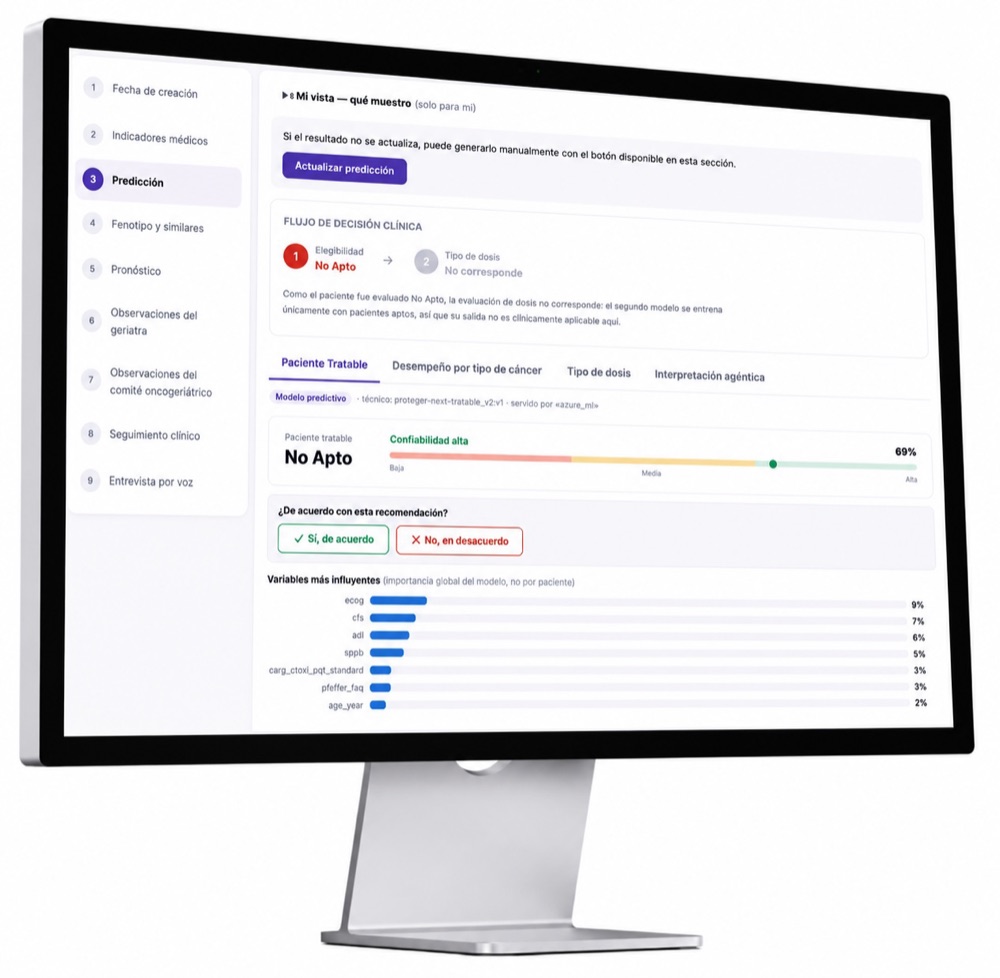
Two complementary models — which talk to each other — produce a recommendation with calibrated reliability and explainability.
- 5
An explainable recommendation
The system shows the recommendation, how reliable it is, and the variables that weighed most (individual SHAP).
What the client gets
Decisions that are informed, transparent and evidence-based.
- 6
A clinical decision, in context
The clinical team reviews the recommendation and decides. It can record agreement or disagreement, leaving a trace.
What the client gets
The AI recommends, the team decides. Always in control.
- 7
Follow-up and continuous improvement
The platform learns from real (anonymised) data to keep improving its models.
What the client gets
Better decisions today, better outcomes for your patients tomorrow.
- 1
Discovery and first contact
The team gets to know PROTEGER and requests a tailored demonstration.
What the client gets
A clear view of the platform's clinical value and its evidence.
- 2
Guided implementation
Onboarding led by our team: installation, integration with existing systems and training.
What the client gets
A quick start and early adoption by the clinical team.
- 3
Patient intake and assessment
The assessment is collected in clinic, by link or by phone — whichever the clinical team chooses.
What the client gets
Structured, complete information for a comprehensive assessment.
- 4
PROTEGER analyzes in 3 stages
- 1Eligibility
- 2Dose intensity
- 3Prognosis
Two complementary models — which talk to each other — produce a recommendation with calibrated reliability and explainability.
- 5
An explainable recommendation
The system shows the recommendation, how reliable it is, and the variables that weighed most (individual SHAP).
What the client gets
Decisions that are informed, transparent and evidence-based.
- 6
A clinical decision, in context
The clinical team reviews the recommendation and decides. It can record agreement or disagreement, leaving a trace.
What the client gets
The AI recommends, the team decides. Always in control.
- 7
Follow-up and continuous improvement
The platform learns from real (anonymised) data to keep improving its models.
What the client gets
Better decisions today, better outcomes for your patients tomorrow.
- The right patient
- The right treatment
- The right intensity
- At the right time
Chilean science, fairer decisions.
HOW THE ASSESSMENT IS COLLECTED
Not every patient is assessed the same way. PROTEGER offers three ways to collect the geriatric assessment, and the choice belongs to the clinical team, patient by patient.
In clinic
The team carries out the assessment as it always has. PROTEGER structures the information and leaves it ready for analysis.
By link
The patient answers from home, at their own pace, on a phone or a computer.
By phone
A voice agent calls and works through the scales in conversation. For those who do not use apps — which describes most older patients.
The agent only asks what the patient can answer for themselves. Anything requiring measurement or examination is done by the team. And if an answer is not reliable, the system does not record it: it tries again, and if it is still unreliable, it refers the patient to an in-person assessment.
KEY FEATURES
THE PLATFORM
PROTEGER brings advanced artificial intelligence together with clinical, oncological and geriatric information to support care teams in one of the hardest decisions in oncology: choosing the right treatment for each older adult with cancer.
Trained and validated in the region, PROTEGER combines predictive models, clinical phenotype characterization and intelligent agents to give a whole view of each patient. That helps reduce the risk of overtreatment and undertreatment, complementing clinical judgment and helping the patient and those around them understand the alternatives.

A new way to support decisions in geriatric oncology, combining artificial intelligence, comprehensive patient assessment and clinical knowledge to move towards treatment tailored to each older adult with cancer.
A whole view of the patient
Brings together each person's clinical, oncological and geriatric characteristics — beyond the diagnosis — and turns them into information you can decide with.
Advanced artificial intelligence
An ecosystem of AI models that complement one another to give a fuller picture of the patient.
Designed for our population
Built from patient data in our region and validated in Chilean hospitals, reflecting the characteristics of the population it sets out to serve.
Support for safer treatment
Gives the clinical team additional information to weigh alternatives and to help identify and reduce treatment-related risks.
Shared decisions
Puts the clinical information into plain language, so the patient and their family take part in the decision with the care team, understanding the options and the risks.
AI that complements the professional
PROTEGER does not replace clinical judgment. It broadens the information available so professionals can make better-founded decisions, while always keeping control of the treatment decision.
At Oncoger, through PROTEGER, we offer a holistic approach that combines artificial intelligence with comprehensive geriatric assessment to make more precise and more personalized decisions.
LEARN MORE
WHAT THE SYSTEM GUARANTEES
A clinical tool is not judged only by what it gets right, but by what it does when it is not sure — and by what it lets you check afterwards.
It does not invent data
Every answer keeps its provenance: whether the patient said it, whether the model interpreted it, with what confidence, and how many times it was asked. A question that was never asked cannot end up as a recorded answer.
No value reaches the record on its own
Whatever the agent captures goes through a review queue: a clinician approves it, corrects it or rejects it. What reaches the record — which is what the model reads — is the clinician's value, not the agent's.
The model is watched
The platform monitors data drift variable by variable. When the population coming through stops resembling the one the model was trained on, you see it — rather than finding out through a bad outcome.
Advanced technology in the service of clinical judgment
PROTEGER simplifies and improves decisions in geriatric oncology with artificial intuitive artificial intelligence. A tool built to empower care teams and to deliver safer, more effective treatment for older adults with cancer.
> 1,000
Patients assessed
> 3 years
of training data
> 7
Validating hospitals
0.84
Eligibility AUC · published
Peer-reviewed publication
Journal of Geriatric Oncology
Volume 17, Issue 6, July 2026, 103031
«Machine learning models as a supporting tool to decide systemic therapy for older adults with cancer»
Read the publication →The first validation of its kind published from Latin America
Peer-reviewed.
PART OF A LARGER PROGRAMME
Precision AI
PROTEGER is part of Precision AI, a technology program led by Universidad del Desarrollo and Universidad de Chile to advance precision oncology in the country. Oncoger takes part as a co-executor, alongside AIDA.
Read the program announcement →The program has international partners
- MIT Jameel Clinic
- London AI Centre for Value Based Healthcare
How does PROTEGER help the care team, the patient and their family?
PROTEGER turns all the relevant patient information into knowledge that is useful and accessible at the point of decision. Its AI ecosystem gives a whole view of each patient, supporting the care team as it weighs treatment alternatives and helping the patient and their family better understand the options, the risks and the factors that matter — so they can take part in a better-informed, shared decision.
What makes PROTEGER different?
It is the only platform of its kind developed and validated with patients from Chile and Latin America: its models carry clinical validation in hospitals across the region and published, peer-reviewed evidence.
Is it easy to use?
Yes. PROTEGER is designed to fit into the clinical workflow without friction. The platform guides the assessment, integrates and analyzes the relevant patient information, and presents the results clearly and in a structured way — so the care team can concentrate on the clinical decision rather than on the technology.
Where has PROTEGER been validated?
PROTEGER has been evaluated and validated using clinical data from hospitals, clinics and health centers in Chile, Peru and Brazil, moving towards multicenter, regional validation.
Its models also have peer-reviewed scientific evidence published in the Journal of Geriatric Oncology, which backs the platform's development and performance.
Peer-reviewed publication
Machine learning models as a supporting tool to decide systemic therapy for older adults with cancer
Journal of Geriatric Oncology, Volume 17, Issue 6, July 2026, 103031.
Read the publication →Would you like to see PROTEGER with your team?
We will arrange a demonstration using cases from your department and go through the evidence behind the models together.
Get in touch
Write to us if you have questions or would like to be part of our community.
FUNDED BY: