
PUBLICATION
PROTEGER in the Journal of Geriatric Oncology: the model that learns from the Oncogeriatric Telecommittee and is validated in external centres
By Oncoger team ·
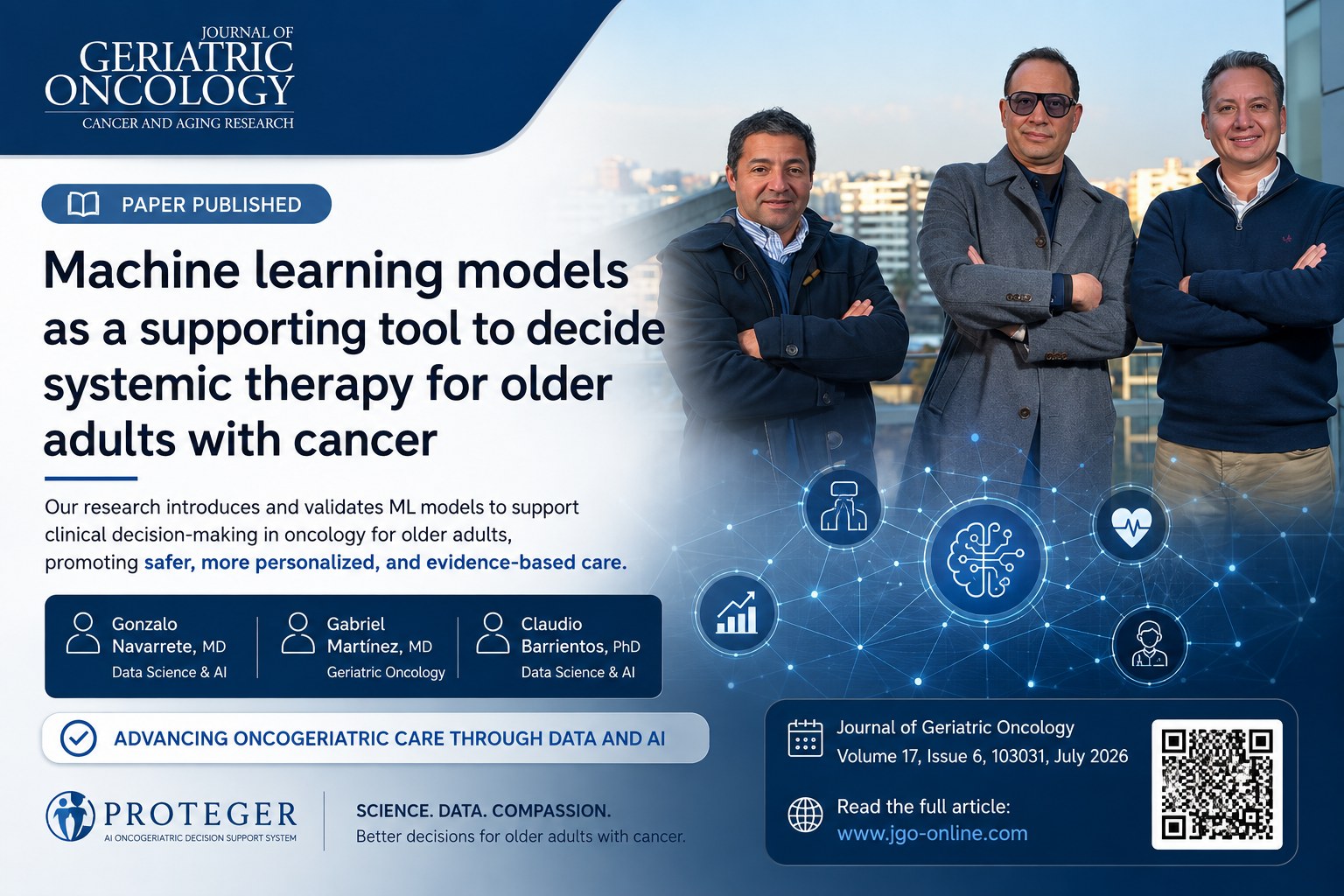
JOURNAL OF GERIATRIC ONCOLOGY · 2026;17:103031 · TRIPOD-AI · ISRCTN11875539
Machine learning models as a supporting tool to decide systemic therapy for older adults with cancer
Navarrete G, Martínez G, Barrientos C, Venegas R, Carvacho C, Wolff P, Contreras C, Gómez-Valenzuela F, Solis L, Muñoz I, Cofré J, Bermudez C, Vernooij R.
357
patients from the Oncogeriatric Telecommittee in the development cohort
272
patients from two tertiary centres in the external validation (2021–2025)
0.84
AUC of the ensemble model against the expert recommendation (95% CI 0.78–0.89)
765 vs 275
days of median survival between eligible and not eligible per the oncogeriatric team
It is the scientific article that underpins PROTEGER. Published as a research letter in the Journal of Geriatric Oncology, the reference journal of the International Society of Geriatric Oncology, it describes how we developed and externally validated a machine-learning model that integrates oncological data and comprehensive geriatric assessment to support the systemic-therapy decision in older people with cancer. It is signed by the full Oncoger team —Gonzalo Navarrete, Gabriel Martínez, Claudio Barrientos and Rodrigo Venegas— together with collaborators from Hospital Dr. Franco Ravera Zunino, the University of Chile, Universidad Mayor, the University of Chile Clinical Hospital, Hospital Digital of the Ministry of Health and the University Medical Centre Utrecht. The study followed the TRIPOD-AI guideline and is registered in ISRCTN.
The starting point
Chile has fewer than 200 geriatricians for the whole country, and cancer is already the leading cause of death. The Oncogeriatric Telecommittee that the Ministry of Health launched in 2021 lets oncology teams from any region present cases of older people with solid tumours remotely to an expert panel, but its ability to scale is limited by the shortage of specialists. The study's question was whether a model trained on that committee's decisions could reproduce its criteria and, with that, help standardise and extend those decisions to centres without access to it.
How it was built
The development cohort brought together 357 adults aged 65 or over with solid tumours assessed by the Telecommittee (median age 78, 50% men, 39% with gastrointestinal cancer). For each patient, oncological and geriatric-assessment variables were collected: Clinical Frailty Scale, ECOG, CARG toxicity score, tumour type and stage, basic and instrumental activities of daily living, SPPB, Charlson comorbidity, falls, depression (GDS), cognition (MMSE), number of drugs, BMI and treatment intent. The primary outcome was the committee's recommendation on systemic therapy. Random forest, XGBoost, logistic regression, a decision tree and an ensemble model by stacking were trained, with Bayesian hyperparameter optimisation and five-fold cross-validation, and validated in 272 patients from two tertiary centres in other regions of the country, assessed between 2021 and 2025.
Discrimination in the external validation (AUC with 95% CI)
Reference: oncogeriatric team's recommendation · n = 272 · 1,000 bootstrap resamples.
What it found
The ensemble model reached an AUC of 0.84 (95% CI 0.78–0.89) in the external validation, with random forest and logistic regression at 0.82 and XGBoost at 0.78. The variables that weighed most on the recommendation were the Clinical Frailty Scale, ECOG, the CARG toxicity score, basic activities of daily living and the oncological diagnosis. And, as expected, patients classified as not eligible were older and had a less favourable geriatric profile: lower SPPB, more comorbidity, more falls, greater frailty, less autonomy and higher toxicity risk.
The most clinically relevant finding is that the classification separates groups with very different survival. Per the oncogeriatric team's decision, median survival was 765 days in those considered eligible for systemic therapy and 275 in those not eligible (p < 0.001). The model reproduces that separation: 522 vs 358 days overall, and at stage IV 335 vs 146 days (p < 0.001).
Median survival by classification, in days
Eligible vs not eligible for systemic therapy, by who classifies and by stage.
| Classification | Group | Median survival |
|---|---|---|
| Oncogeriatric team | All | 765 275 |
| Stages I–III | 827 446 | |
| Stage IV | 310 132 | |
| Ensemble model | All | 522 358 |
| Stages I–III | 827 358 | |
| Stage IV | 335 146 |
What it means for the health system
The authors argue that a model like this can help identify high-risk older people with cancer for whom alternative care is more appropriate, reducing unnecessary treatments and chemotherapy toxicity, shortening waiting lists and easing the financial pressure on public systems. In patients with stage IV disease considered not eligible, it can also be the trigger for serious-illness conversations that align the medical decision with the patient's values, goals and preferences. It could also improve the selection of older people for clinical trials, a group historically underrepresented and with higher dropout rates from adverse events.
The article is explicit about its limits: it is an exploratory, retrospective evaluation, it requires a full geriatric assessment that not all centres can perform, the survival differences may be confounded by the treatment actually received, and there is a risk of automation bias in both directions. A prospective validation is under way. And the rule is a single one: PROTEGER is strictly a support tool; the final responsibility remains with the treating physician and the multidisciplinary team.
Machine-learning-based treatment recommendations for older adults with cancer could optimise the use of systemic therapy, reduce costs, improve quality of life, trigger serious-illness conversations and improve access to palliative care, benefiting both people and public health systems.
Links
Navarrete G, Martínez G, Barrientos C, Venegas R, Carvacho C, Wolff P, Contreras C, Gómez-Valenzuela F, Solis L, Muñoz I, Cofré J, Bermudez C, Vernooij R. Machine learning models as a supporting tool to decide systemic therapy for older adults with cancer. J Geriatr Oncol. 2026;17:103031. doi:10.1016/j.jgo.2026.103031. Funded by CORFO (23CVC-245919). Approved by the ethics committees of the University of Chile Clinical Hospital and the Rancagua Regional Hospital.